Pole dancing is a discipline that uses a vertical bar (called a pole) to execute movements.
Although it has become quite popular around the world in recent years, many people’s vision of the discipline remains heavily linked to strippers. But little (or nothing) is said about the other branches that pole dancing has, ones that go far beyond the sensual.
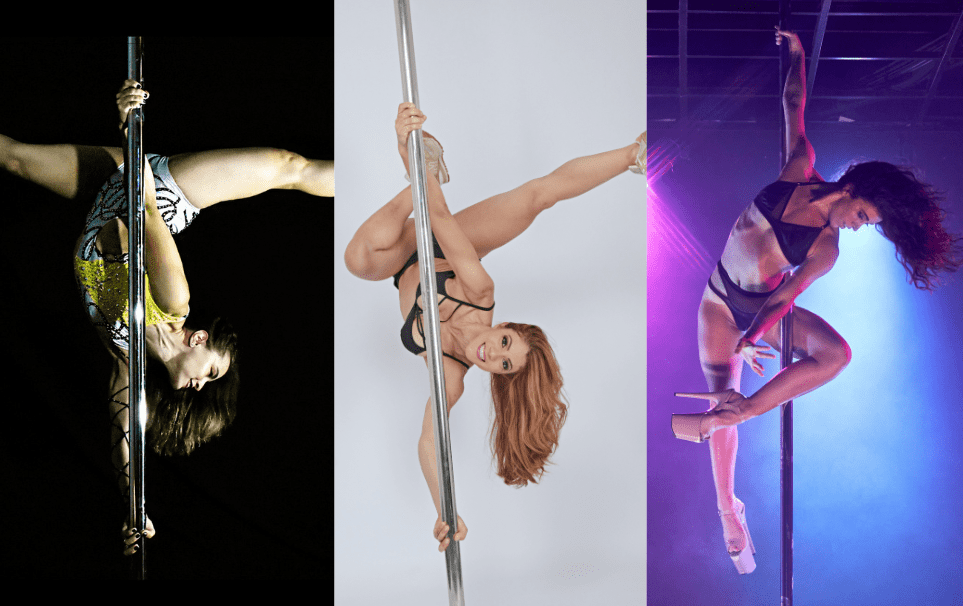
So, in this post we’ll talk a bit more about the most popular and commonly practised types of pole dance in studios:
Types of Pole Dancing
Pole Sport
That’s right! Pole dance has its sports branch and is even fighting to become an Olympic event.
Pole sport is one of the types of pole dancing that closely resembles rhythmic or Olympic gymnastics, but using a vertical bar (the pole). This branch trains muscle groups in an integrated way: you could say arms, abdomen, legs and hips are the most used.

It’s worth noting that in class there is no choreography, but rather combos of movements, with strong emphasis on strength work so as to make clean movements.
Furthermore, this branch does not practice sensuality or the use of high heels. Indeed, official competition regulations are strictly rigid about costumes, forbidding plunging necklines and even specifying short-length limits.
That is because there are federations that govern the competitions and possess official regulations, including point tables according to each movement.
Among Latin American countries, Brazil and Mexico have always stood out in the global rankings.
Pole sport: the pole dance as a sporting discipline
The pole sport branch of pole dance is a true demonstration of strength and technique, standing out for its athletic and rigorous approach. Unlike the sensual pole dance style, pole sport focuses on precise execution of acrobatic moves and complex combinations on the vertical bar. Athletes in this discipline are judged based on technical ability, body control and clean execution of tricks, following standards set by international federations.
Exotic Pole

You have probably seen videos of pole dancers wearing very high heels, amazing and bold costumes, floor work and lots of spins. That’s exotic pole!
Within Exotic Pole you explore a lot of sensuality with stronger movements: faces, lips, strong footwork and ground moves, using the knees a lot. In this class, the presence of high heels and knee pads is a required element!
This style began in Russia and remains very popular there, where dancers are known for their strength and impeccable technique.
Pole Art
Because it has an artistic bias, this branch requires the practitioner to demonstrate a lot of lightness and fluidity in movements which, consequently, requires significant strength. In artistic pole (pole art), the practitioner appears to float and be an integral part of the pole.
There are also several regulated pole art competitions both in Brazil and around the world. In them, performances are thematic and often accompanied by an explanation, letting the viewer enter a world created by that performance.
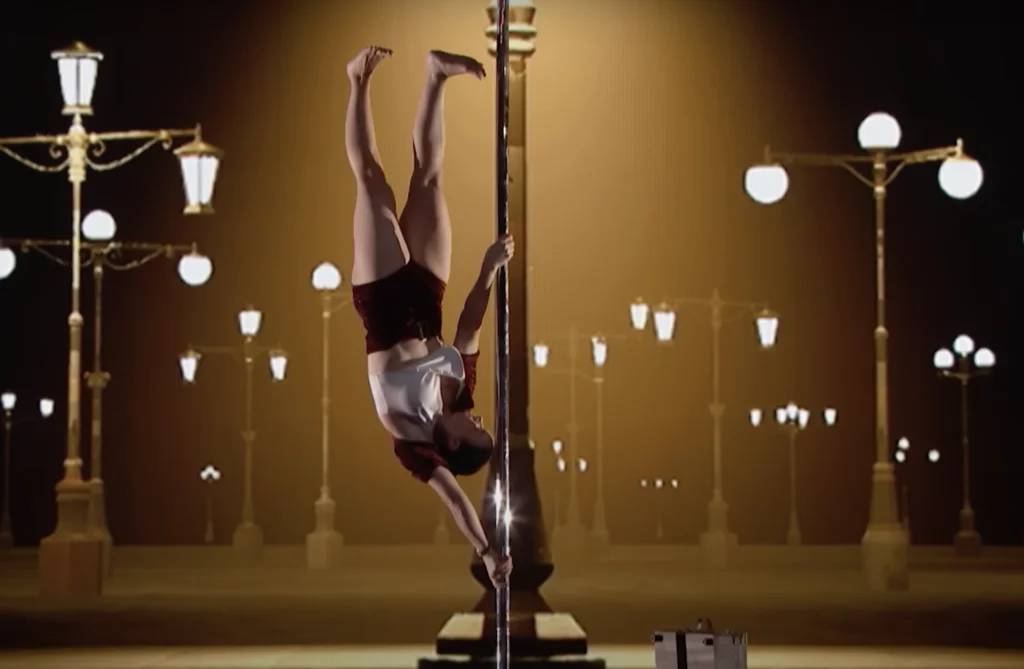
Competitors are judged by how effectively they interpret the theme through the chosen dance style, with emphasis on artistry, musicality and fluidity.
For example: In the 17th season of America’s Got Talent in 2022, Kristy Sellars introduced the world to pole art with her incredible multimedia performances and earned second place in the competition.
Sub-branches of Pole Dancing
Well, but pole dance does not live only on the “official” branches! Let’s now talk a little about the variations you can also find in studios around the world, but which do not have official championships or even specific point tables. We could say these are sub-branches of pole dancing.
Choreographic Pole
Choreographic pole consists of strength and flexibility movements based on various dance languages. With the aid of the bar, transitions between movements are worked on in order to build musicality within a choreography.
Some studios further subdivide Choreographic Pole, either by musical genre, like Pole Funk, or by dance style, such as Contemporary Pole and Pole Flow, for example.
In some of them, the pole is only one element, and not the main figure, unlike what happens in the three branches mentioned above.
Sensual Pole
Sensual pole is one of the types of pole dancing that most emphasises sensuality, with a lot of eye contact, floor-moves, head-hair flips and bold outfits. As mentioned earlier, this is perhaps the best-known style of pole dancing because it’s the one most associated with the stereotype of strippers.
Many festivals have a rule in the sensual category that a piece of clothing must be removed. It’s very important to emphasise that this doesn’t mean anyone who follows this branch is automatically a stripper. These are distinct things.
Pole Silk
Also called “pole aria”, this branch blends pole dancing with fabric acrobatics and aerial dance elements. In addition to the artistic angle, pole silk is a great ally for anyone who wants more body awareness, flexibility and movement fluidity. Here we discuss a little more about pole silk and the kit pole silk by Gaia Pole.
Pole Fitness
Pole fitness has the distinguishing feature of being executed with more complete movements from a physical exercise perspective.
The goal of this branch is to work as many muscles as possible at the same time, exercising the entire body.
Benefits of Pole Fitness
Because it is so complete, pole fitness delivers a range of body benefits. Among the main ones are joint and muscle strengthening and calorie burning.
Furthermore, the modality is an excellent option for isometric and cardiovascular exercise, being more intense than usual aerobic activity.
Other important benefits of pole fitness include:
- Increased vigor and energy;
- Development of balance;
- Improved sleep quality;
- Reduced stress.
Believe it: pole dancing training itself will prepare you for the kind of strength you need.
There are many other sub-branches spread across studios worldwide, and the best thing of all is that regardless of which one it is, you do not need advanced strength or flexibility to start. Everyone can (and should) begin right now, with their own body and clothing, and over the classes feel the evolution.
So if you’re thinking about getting to know this discipline so loved by all of us, our advice is: Take trial classes in more than one style until you find the one that fits your personality the most. You will not regret it!
Whether your goal is to refine physical fitness, express yourself artistically, or simply to have fun, pole dancing offers a rich variety of possibilities. By exploring the different types of pole dancing, practitioners can find the style that best aligns with their interests and enjoy an engaging and empowering training experience.
Check also: Benefits of pole dance
Some Products

ALL IN ONE ARTICULATED PORTABLE POLE
$699.90CORNER SUPPORT FOR POLES
$239.00EASY PORTABLE POLE
$549.90EASY REMOVABLE POLE
$399.00